Confirmed facts: what FDA published
Source boundary. Every factual statement in this section comes from FDA's early alert, published October 9, 2026. Analysis begins in the next section and is labeled as such.
What this is. FDA states that CDRH is issuing an Early Alert to notify the public of a potentially high-risk device issue. An early alert is an early-stage public communication. It is not a classified recall, and the page does not state a recall classification. FDA notes it is reviewing information about the issue and will update the page as significant new information becomes available. Treat the facts below as the position on the page at the date given, not as a settled record.
Product. The Philips Lumify Diagnostic Ultrasound System. The alert identifies affected products by software version and UDI-DI rather than by model number, covering iOS versions 2.X, 5.0, 5.1.2 and 5.1.3, and Android versions 1.X, 3.X, 4.X, 5.1 and 5.1.1. The page does not give distribution dates or the number of devices affected.
The problem, as FDA describes it. A software app or transducer connection problem that can cause loss of, or delays in, scanning functionality. It presents in two ways.
Registration. Per the alert, the app may not recognize a previously registered transducer. Users are then prompted to re-register without warning before point-of-care use, and scanning is blocked until registration is complete. Registration requires Wi-Fi or cellular access. Philips has received reports of pre-hospital events, outside Wi-Fi or cellular coverage, where these prompts prevented scanning and delayed care.
Physical connection. The connection between the transducer's USB cable and a tablet or phone may disconnect or become unstable during use, interrupting continuous function and delaying care.
Reported harm. Philips has reported eight serious injuries and four deaths associated with this issue, as of September 29, 2026. FDA's wording is "associated with." The page does not state that the issue caused those outcomes, and this article does not either. Reported association is not a determination of individual causation.
Manufacturer communication. Philips issued a customer letter dated September 24, 2026.
Interim actions Philips recommended. Use the system only where Wi-Fi or cellular signals are readily accessible, unless a backup ultrasound device is immediately available. Always keep backup ultrasound devices or other modalities available. Circulate the Philips letter to all device users. Post the Philips notice near affected units.
What is not resolved. Philips is developing a software update for the registration issue. It has not been released. Philips will send a follow-up communication with the update and any required actions once available. Philips is separately assessing the cause of the USB and cable connection problem and identifying a solution. Both remain open on the cited page.
Bayou Vantage analysis
Everything from this point is Bayou Vantage analysis. It is a governance model, not an FDA recommendation, and FDA has not reviewed or endorsed it.
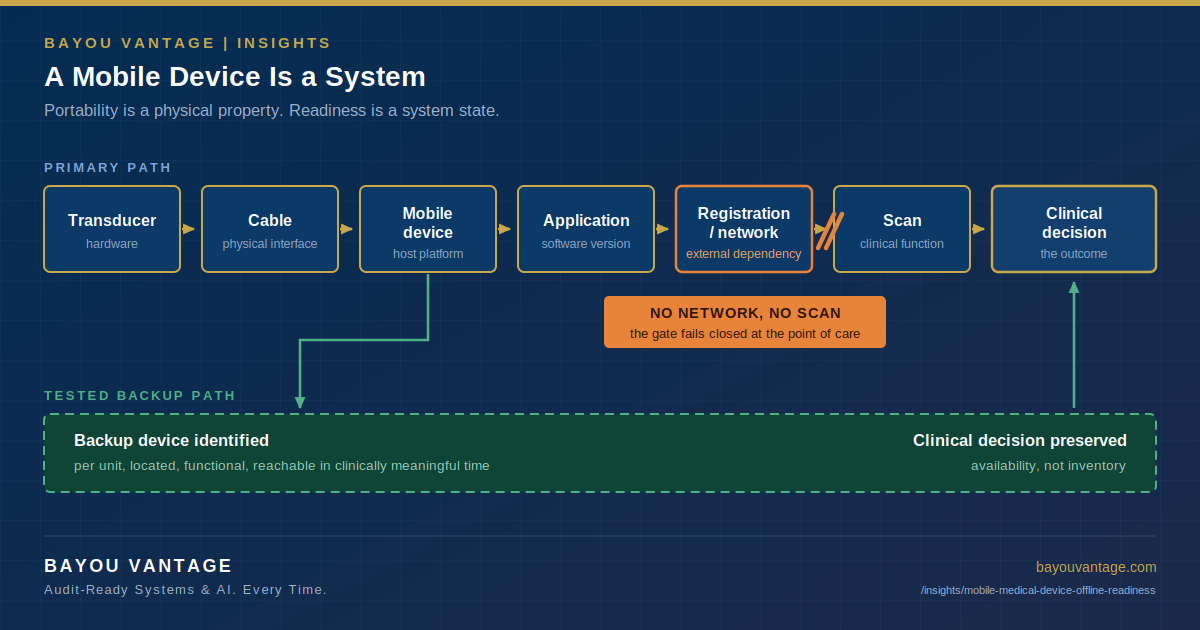
Portability is a physical property. Readiness is a system state.
A portable device is easy to describe. It fits in a bag, it runs on a tablet, a clinician carries it to the patient instead of moving the patient to it. That description is about mass and dimensions.
Readiness is a different property entirely, and it is not carried in the bag. It is the state of everything the device needs in order to function at the moment of use: a host platform in a supported configuration, an application in a supported version, a valid registration or entitlement state, a network path when the design requires one, an intact physical connection, a user who knows what to do when any of that fails, and a backup that is actually available rather than nominally available.
The gap between those two properties is where this alert lives. A device can be fully portable and not at all ready. Worse, it can be ready in every location where it was evaluated and unready in the one place it was designed to go.
That inversion is what makes this case worth an hour of executive attention even for organizations that do not own a single ultrasound. The failure did not occur despite the device being portable. It occurred because portability took the device somewhere its dependency chain did not reach.
Map the device that care actually depends on
Most organizations can produce an asset record for a mobile device. Far fewer can produce a dependency map.
The asset record says what you own. The dependency map says what has to be true for the thing to work. For a connected mobile device, that list is longer than the purchase order:
Hardware, meaning the sensor, probe or transducer itself
Physical interfaces, meaning cables, connectors, ports and adapters, including their mechanical durability under movement
Host platform, meaning the specific tablet or phone models, operating system versions and configurations that are supported
Application, meaning the installed version and its update state
Registration, licensing or entitlement state, meaning whatever the software checks before it will run
Connectivity, meaning which functions require a network, which network types qualify, and what happens when none is present
Procedures, meaning what the user is instructed to do, including when something fails
Backup, meaning the alternative pathway and its real availability at the point of care
Run your own inventory against that list and the common finding is predictable. Hardware and application are tracked. Host platform is sometimes tracked. Registration state is rarely tracked as an asset attribute at all, and backup availability is almost never tracked per unit.
Those last two are exactly the ones that failed here.
Treat registration as an availability control
This is the transferable lesson, and it reaches well past ultrasound.
A registration check, a license validation, an entitlement lookup, a certificate renewal, a token refresh, a cloud authentication handshake: each of these is a gate the software passes through before it will perform its function. Each was designed as a commercial or security control. None was designed as a clinical availability control. But at the point of care, that is exactly what each one is, because when the gate does not open the device does not work.
Three properties make such a gate dangerous:
It is silent until it fires. A registration that has worked a hundred times gives no indication that the hundred-and-first will prompt. The user has no signal to plan around.
Its dependency is external. The gate needs something outside the device, a server, a network, a credential service. The organization controls neither the availability of that dependency nor, in many cases, the vendor's decision to require it.
It fails closed. A security gate that fails closed is behaving correctly from a security standpoint. From a clinical standpoint, failing closed means the function stops. Those two framings are in direct tension, and the tension is usually never adjudicated because the two groups who care about it rarely meet.
Questions to put to any connected device in your estate, and to any vendor proposing one:
What checks does the software perform before it will function, and which of them require an external connection?
Under what conditions can a previously valid state be invalidated, and can that happen without warning?
When a check fails, what exactly happens to the clinical function? Does it degrade, queue, continue in a limited mode, or stop?
Is there a documented offline or grace-period path, and has anyone tested it?
Who in our organization owns the state that the check depends on, and do they know they own it?
Question three is the one that separates a nuisance from an event. A device that degrades gracefully is an inconvenience. A device that stops, at the point of care, with no warning, in a location chosen precisely because it is remote, is a different category of problem.
Validate the intended use environment
Validation performed in a hospital corridor with full Wi-Fi tells you the device works in a hospital corridor with full Wi-Fi.
A portable device's intended use environment is, by definition, variable. If the device is marketed for point-of-care use, the environments where it will be used include the ones where everything is harder. Validation has to go there, or it has not validated the intended use.
The conditions that belong in a use-environment test protocol for a mobile connected device:
No network, meaning airplane mode or a genuine dead zone, not a weak signal
Weak and intermittent network, which is often worse than none, because the software may hang rather than fail
Network transition, moving between Wi-Fi and cellular, or between access points, mid-use
Each supported host platform, across the operating system versions actually in the field, not only the newest
Transport conditions, meaning the device in a bag, in a vehicle, exposed to vibration and temperature swings
Cable movement under load, meaning repeated connection and disconnection, flexing at the strain relief, tension during use
Time pressure, meaning a user performing the task against a clock rather than at a bench
User transitions, meaning handoff between clinicians, shift change, a user who did not set the device up
The last two are the ones most often omitted, and they are the ones that distinguish a human factors study from a demonstration. A workflow that functions when an unhurried, trained, originating user runs it tells you very little about what happens at 3 a.m. in the back of a moving vehicle with a different clinician who inherited the device mid-shift.
Control the interim measure
A manufacturer's interim recommendation is a communication. It becomes a control only when the receiving organization converts it into something with an owner, a state and a record.
Compare the two. The notice says keep a backup available. The control says: for each of our 41 affected units, a named individual has confirmed which specific backup device serves it, where that backup physically is, that it is functional, and that the users of the primary unit know both facts.
Converting a notice into a control takes six steps:
Unit-level ownership. A named person per unit or per deployment location, not a department.
Posted instructions. At the unit, where the user is, not in a shared drive.
Training confirmed by individual. Not "the letter was circulated," but a record of who received it and acknowledged it, including per-diem and float staff.
Network accessibility defined concretely. If the instruction is to operate only where signal is readily accessible, somebody has to define which locations qualify and tell users which of their locations do not.
Backup demonstrably available. Identified, located, functional and reachable within a clinically meaningful time. An inventory entry is not availability.
Exception path. What a user does when the conditions cannot be met. Without this, the instruction is unfollowable in exactly the situation it was written for, and users will improvise.
Point four deserves emphasis because it is where this particular instruction gets hard. A directive to operate only where signal is readily accessible, given to a pre-hospital team, constrains clinical practice in a way the receiving organization has to think through rather than simply relay.
Reconcile the affected population
Field corrections fail at reconciliation more often than at execution. The action gets taken. Nobody can prove it was taken everywhere.
Reconciliation means a record with one row per unit and a defined set of columns, each of which must reach a terminal state:
Attribute | Why it matters here |
|---|---|
Unique identifier | Serial or asset tag, the row's primary key |
Physical location and assignment | Including units off-site, in vehicles, or with a service |
Software version | The alert is scoped by version, so this determines whether a unit is in scope |
Host platform and OS version | The dependency most often missing from device records |
Registration or entitlement state | Rarely tracked, and central to this issue |
Interim control status | Notice posted, users trained, confirmed by whom and when |
Backup identified and verified | Which device, where, confirmed functional by whom |
Update status | Once the software update is released |
Three population problems to anticipate, because they are where the count goes wrong: units assigned to a service or an agency rather than a department, units in transit or in loaner pools, and units whose host platform is personally owned or shared and therefore absent from the medical device inventory entirely.
A reconciliation that reaches 100 percent of the units you knew about, having never tested whether that denominator was right, is not a reconciliation.
Separate deployment from effectiveness
Deployment asks whether the action was taken. Effectiveness asks whether the action works. Organizations routinely close corrections on the first and report it as the second.
Deployment evidence is confirmation of installation or posting, a functional check after the change, and a record per unit.
Effectiveness evidence is harder and more valuable:
Behavior under the failure condition. Does the device now behave acceptably with no network, which means testing it offline rather than inferring from a release note.
User acceptance in context. Can the actual users, in their actual environment, do the thing the instruction requires.
Exception handling. When a user hits the condition the control was built for, does the defined path work and does anyone find out it was used.
Retained evidence. Records that survive the people involved and are findable without asking them.
When the fix is a software update that has not shipped, as is the case here, effectiveness verification applies to the interim control rather than to the fix. The question is not whether the update works. It is whether the backup is genuinely available and the instruction is genuinely followable, measured in the field rather than assumed from the fact that a letter was sent.
Trend across technical and clinical evidence
Signals about this class of failure arrive in separate systems owned by separate functions, and each stream alone looks like noise.
Complaints hold user reports of prompts and failures. Service data holds cable and connector replacements. Technical logs hold registration events and connection drops. Clinical records hold delays. Safety reporting holds adverse events.
Nobody is usually looking across all five. The service team sees a cable replacement rate and reads it as wear. The complaint team sees scattered registration reports and reads them as user error. The clinical side sees occasional delays and attributes them to conditions. Only the combination shows a pattern.
Build the cross-stream view deliberately:
Align the streams on a common unit identifier and a common clock
Segment by software version, host platform and location type
Look for co-occurrence rather than volume, meaning registration events clustered with delays, or connector replacements clustered on particular deployments
On causal language, which matters. Co-occurrence is not causation, and in a safety context overstating it is its own failure. The correct posture in a trend report is to describe the association, state what would be required to establish causation, and escalate on the strength of the association without claiming more than the data supports. FDA's own wording in this alert, that the injuries and deaths are reported as associated with the issue, is the model. Use that register.
Run a no-network drill
A diagnostic you can run this month on one workflow.
Pick one mobile connected device and one clinical workflow that depends on it. Choose the workflow where a delay would matter most, which is usually the one performed furthest from the building.
Set the condition. Take the device to a genuine dead zone, or put the host in airplane mode. Not a weak signal. No network.
Attempt the workflow end to end, with a user who normally performs it, not with the person who organized the drill.
Observe and record six things:
Does the device perform the clinical function, fully, partially, or not at all
If it prompts, what does it ask for and is that achievable in this location
How long from attempt to the user understanding that it will not work
Does the user know what to do next, from memory, without looking it up
Is the backup reachable, functional, and in use within a clinically meaningful time
Did anything about this event generate a record that anyone else would ever see
Then add one variation: have the device handed to a second user mid-workflow, as happens at a shift change, and run it again.
What the result tells you. Item four is the one that most often fails, and it fails even in organizations where the written procedure is correct, because the procedure was distributed rather than practiced. Item six is the one that determines whether you will ever learn about the next occurrence. A failure that generates no record is a failure your trending will never see.
If the drill goes cleanly, you have evidence of operational readiness for that workflow and a repeatable method for the rest. If it does not, you have found it in a drill rather than in an event.
Executive close
Three conclusions worth carrying out of this.
The device is the system, not the hardware. A connected mobile device includes its host platform, its software state, its entitlement state, its network dependency, its physical connections, its procedures and its backup. An organization that governs only the hardware is governing a component.
Dependencies that nobody owns are the ones that fail. Registration state, host platform configuration and backup availability share a property: they sit between functions. Clinical engineering, IT and Quality each reasonably assume one of the others has it. The remedy is not a new process, it is a named owner per attribute, written down.
Readiness is proven where the device is used. Not in a validation lab, not in a conference room, not in a training environment with full connectivity. Under the conditions in which failure actually matters, which for a portable device means the conditions that made it portable in the first place.
That last point is the whole argument. A device carried to the patient is a device carried away from the infrastructure. If the readiness evidence was generated inside the infrastructure, it does not describe the use.
Can your organization prove that its connected and mobile devices remain usable, or fail safely, when registration, connectivity or a physical interface becomes unavailable? Bayou Vantage's Digital Quality and Operational Readiness review evaluates system dependencies, use-environment testing, interim controls, backup pathways, correction reconciliation and inspection evidence. Contact Bayou Vantage to scope the review.
Primary source
U.S. Food and Drug Administration, Center for Devices and Radiological Health. Early Alert: Diagnostic Ultrasound System Issue from Philips Ultrasound. Published October 9, 2026; page content current as of October 9, 2026. Reported injury and death counts stated as of September 29, 2026. Philips customer communication dated September 24, 2026.
Read the early alert on FDA.gov
Status and limitations. This is an early alert, which FDA issues to notify the public of a potentially high-risk device issue. It is not a classified recall and the page states no recall classification. FDA states it is reviewing information and will update the page as significant new information becomes available, so the facts summarized here reflect the page at the date cited and may have changed.
The eight serious injuries and four deaths were reported by Philips as associated with this issue. Neither FDA's page nor this article states that the issue caused any individual outcome. At the time of the cited page, the software update for the registration issue was still in development and not released, and the cause of the USB and cable connection problem, together with its solution, remained under assessment.
Fact and analysis. Facts attributed to FDA appear in the "Confirmed facts" section and are paraphrased rather than reproduced. The dependency map, the registration-as-availability-control framing, the use-environment test conditions, the interim-control conversion, the reconciliation attributes, the deployment and effectiveness distinction, the cross-stream trending method and the no-network drill are Bayou Vantage analysis. FDA has not reviewed, endorsed or adopted any of it.
Verify before relying on this. Check the FDA page directly for current status.
Scope the review
Can your organization prove that its connected and mobile devices remain usable, or fail safely, when registration, connectivity or a physical interface becomes unavailable?
Bayou Vantage's Digital Quality and Operational Readiness review evaluates system dependencies, use-environment testing, interim controls, backup pathways, correction reconciliation and inspection evidence.